SEO and Local Search for Small Businesses
SEO (Search Engine Optimisation) is the process of making your website more visible to search engines like Google, and increasingly to AI tools that recommend businesses to users. The more visible your website is, the more traffic it attracts. Traffic becomes leads, and leads become sales. SEO is not a one-time task. It is an ongoing process, and when done right, it is the most cost-effective way to grow a small business online.
What Makes a Website Visible to Search Engines?
Search engines work like an enormous library. When someone types a question into Google, or asks an AI tool like Claude, the search engine scans millions of indexed websites and returns the results it believes best match what the user is looking for. Your job is to make sure your website is easy to find, easy to understand, and worth recommending.
There are five factors that most directly determine how visible your website is.
1. Heading Structure and On-Page SEO
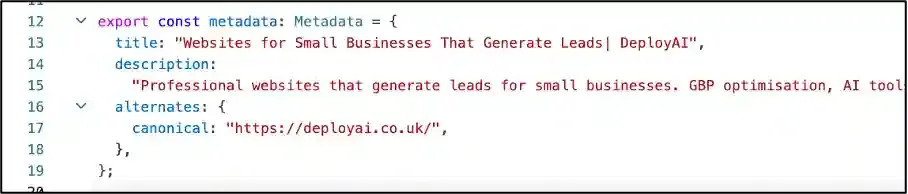
Websites are built from lines of code. Search engines read that code to understand what each page is about, who it is for, and where it belongs in their index. Getting this right is what on-page SEO means in practice.
Page Title
Your page title is the first thing a user sees when your website appears in search results. It is also the primary signal search engines use to understand what a page is about. A good title hooks your target audience, contains your most relevant keywords, and stays under 60 characters, any longer and it gets cut off in results.
Here is a real example. Junior's Auto Workshop is a car garage in Hitchin, Hertfordshire & is our first client. After analysing their bookings, enquiries, and local search data, we identified that their customers searched for terms like “car garage near me”, “MOT near me”, and “car repair Hitchin.” We also found that the most common car makes in the area were Ford, Volkswagen, and Audi. So their title was built to include the most relevant search keywords, their location, and the specific car makes their customers drive, all within 60 characters.

That level of detail came directly from having a lead capture form and booking database on their website. Data from real enquiries is the most accurate keyword research tool you have. Read more about lead capture on our lead generation websites page.
Meta Description
The meta description is the two lines that appear beneath your title in search results. It does not directly affect your ranking, but it directly affects whether someone clicks. Think of it as your 155-character sales pitch. Why should the user choose your result over the nine others on the page?
We cover meta descriptions in detail on our metadata page.
Header Structure
Below the title and meta description, your page needs a clear content hierarchy using heading tags such as H1, H2, H3, and so on. Search engines use this structure to understand the main topics of a page and how they relate to each other. A page without proper heading structure is like a book without chapters, readable by a human who is patient, but ignored by a machine that is not.
Poor heading structure directly hurts your findability. It is one of the most common and most avoidable SEO mistakes on small business websites.
2. Domain Age
How long your domain has been registered and actively used plays a role in how much confidence search engines place in your website. An older, consistently active domain signals legitimacy. There is no shortcut here, the only thing you can do is stay in the game. Every month you are online and publishing useful content, your domain is building credibility.
3. Domain Authority
Domain authority is a measure of how credible and trustworthy your website appears to search engines. It is built over time through the quality of your content, who links to you, and how well-established your online presence is.
A useful way to think about it: if someone asks Google or Claude about UK small business tax rates, there will be thousands of results. Some will come from personal blogs and some will come from gov.uk. Search engines are not neutral, they weight results by credibility. Gov.uk wins because it is an authoritative source. Your goal is to become the authoritative source in your niche and your area.
Read our guide on how to increase your domain authority.
4. How Often Your Website Is Updated
Search engines favour websites that are regularly updated with fresh, relevant content. If the last change to your website was in 1999, there is little reason for Google to prioritise it over a competitor who is actively publishing new content.
The good news is that keeping your website updated does not have to be a manual, time-consuming process. Blog posts, case studies, new service pages, and automated content updates all count.
Read about how we automate website updates for our clients.
5. How Long Visitors Stay on Your Website
Google and other search engines track how users behave after clicking a search result. If someone clicks your website and leaves within seconds, that is a signal that your page did not answer their question. If they stay for several minutes, read multiple pages, and then submit an enquiry, this is a strong signal that your content is genuinely useful.
The most effective way to keep visitors on your website is also the simplest: answer their questions honestly and thoroughly. Most businesses avoid this either because they do not realise they need to, do not have the time, or are uncomfortable addressing the topics their customers actually care about including price, comparisons, and problems.
There is an excellent book on this subject: They Ask, You Answer by Marcus Sheridan. It is one of the most practical business books written about content and trust, and it is the philosophy behind much of how we approach content strategy for our clients. You can find more at marcussheridan.com or listen to it on Spotify if you have a premium subscription.
Ready to Get Found?
If you want to skip the trial and error, hours of reading and studying and want to have fun building a website you are genuinely proud of (one that ranks, attracts the right visitors, and converts them into leads) we would love to help, just fill the form below
Local Search
Local search is what happens when someone searches for a business or service near them. If you have ever typed “Italian restaurants near me” or “car garage Hitchin” into Google, you have used local search. The results that appear in the map, with star ratings and opening hours, are local search results and they are powered by Google Business Profile.
For local businesses, showing up in these results is often more valuable than ranking in the standard search results below. The user is already nearby, already looking, and already close to a decision.
Why Local Search Matters for Small Businesses
Local search and standard search results are closely linked, the same signals that help you rank on Google also help you rank on Google Maps. But local search adds a few factors of its own, and the single biggest one is reviews.
The quality and quantity of your Google reviews directly affect where you appear in local search results. A business with 80 genuine four and five star reviews will consistently outrank a competitor with eight reviews, even if the competitor's website is technically stronger.
Interested in going deeper? Read our guides on how to improve your local search ranking and how to organically increase your Google Reviews.
What Affects Your Local Search Ranking
The main factors Google uses to rank local results are:
Relevance
Does your business match what the user is searching for? This comes from your Google Business Profile categories, your website content, and the keywords associated with your listing.
Distance
How close is your business to the person searching? You cannot control your location, but you can make sure Google knows exactly where you are.
Prominence
How well-known and trusted is your business online? This is where reviews, your website's domain authority, and mentions across the web all feed in.
Ready to Get Found?
If you want to skip the trial and error, hours of reading and studying and want to have fun building a website you are genuinely proud of (one that ranks, attracts the right visitors, and converts them into leads) we would love to help, just fill the form below